Where to watch masters at work, which pieces are worth bringing home and how to tell a hand-made treasure from a factory copy – with Uzbekistan in depth and a profile of every country we cover.
Uzbekistan
Uzbekistan: the heart of Silk Road craftsmanship
For more than a thousand years the oases of Samarkand, Bukhara, Khiva and the Fergana Valley supplied caravans with silk, ceramics, paper and metalwork. Many workshops are still run by the same families, and most of them welcome visitors – often with tea, a demonstration and the chance to try the craft yourself.
Ceramics: Rishtan and Gijduvan
Uzbekistan has several pottery schools, and two of them define the country’s ceramics. Each is recognisable at a glance once you know what to look for.
Rishtan (Fergana Valley)
Rishtan’s fine red clay and its alkaline glaze, ishkor, made from the ash of desert plants, produce the famous turquoise, cobalt and white palette. Plates and bowls are covered with dense floral and pomegranate motifs painted by hand with a fine brush. Around a thousand potters still work in the town.
Gijduvan (Bukhara region)
Gijduvan ware glows in brown, ochre, amber and green, with bold geometric stars and circles radiating from the centre. The glaze is lead-free in the best workshops today, and the pieces are fired in traditional kilns. The Narzullaev family of masters is the best-known name.
Other schools
Look out for the green and brown slip-painted ware of Khorezm, the figurines and whistles of Urgut and Samarkand, and the toys of the Kattakurgan masters – affordable, light and easy to pack.
Workshops & classes
In Rishtan the workshops of Rustam Usmanov and Alisher Nazirov show the whole process, from clay preparation to painting and firing. In Gijduvan the Narzullaev family runs a ceramics museum and workshop. Both offer hands-on wheel and painting classes of one to three hours; we book them in advance and can arrange to ship fired pieces home.
Silk weaving & carpet making
Silk is the thread that gave the Silk Road its name, and Uzbekistan is still one of the world’s leading producers. You can follow the whole chain from cocoon to finished cloth.
Margilan ikat: khan-atlas and adras
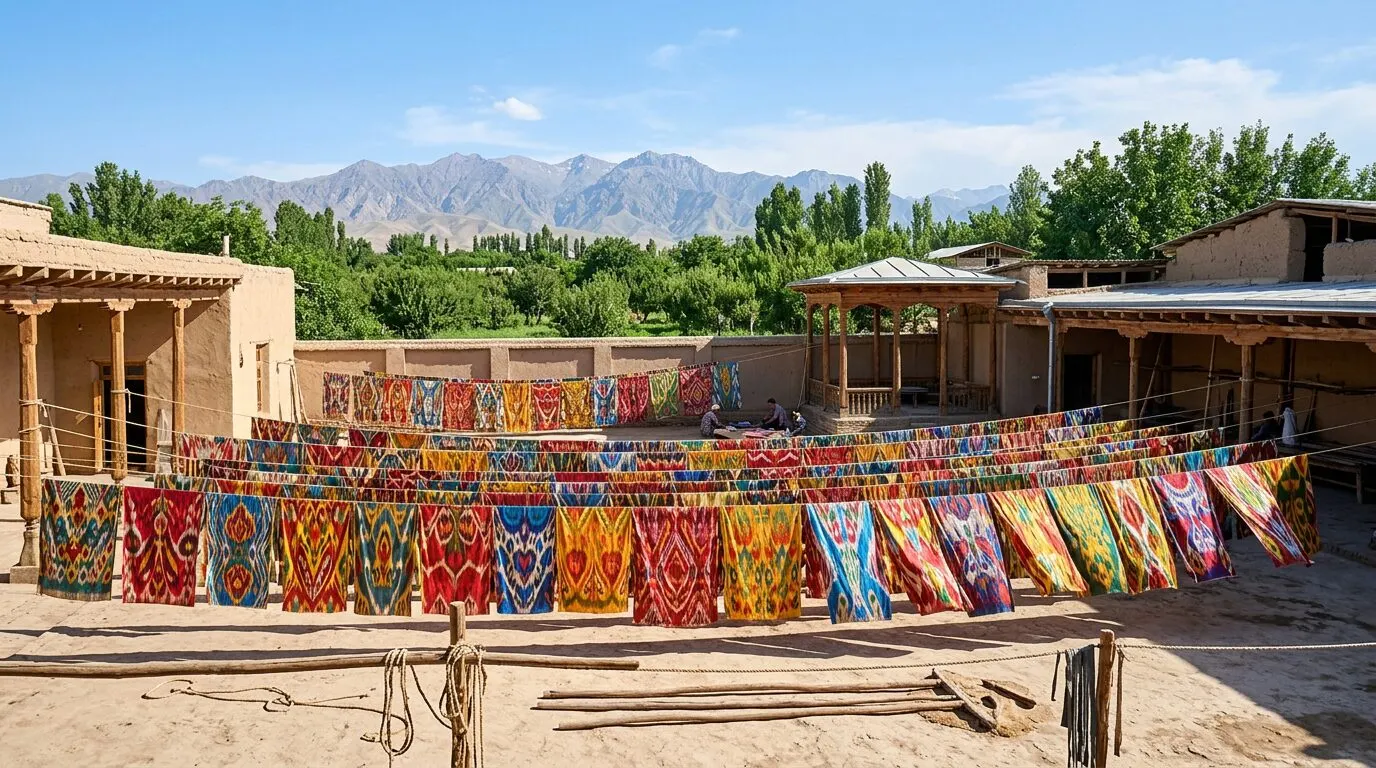
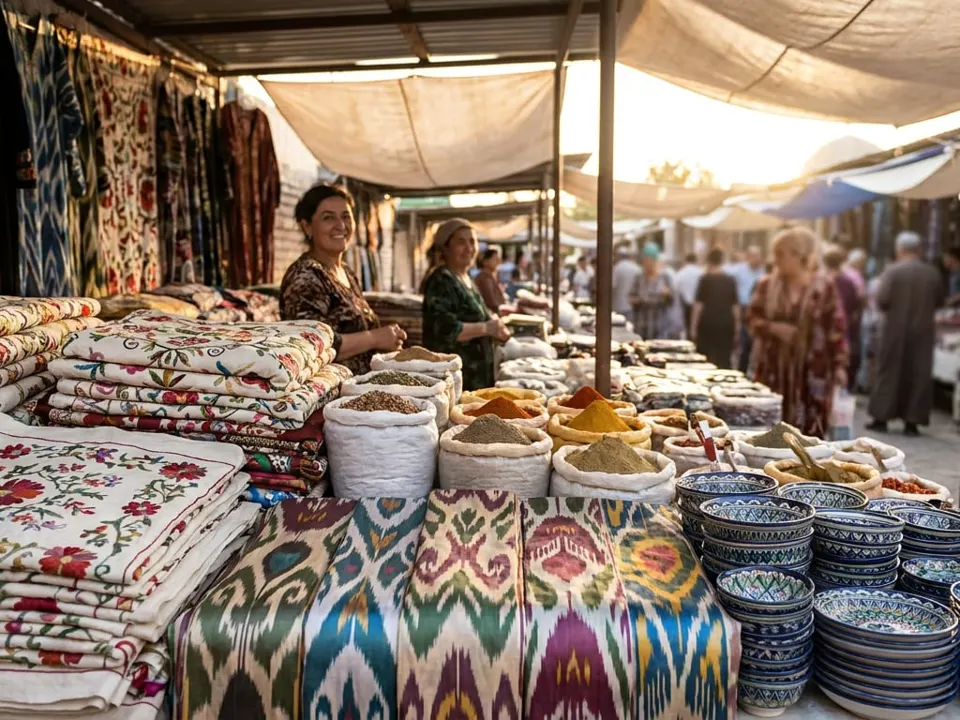
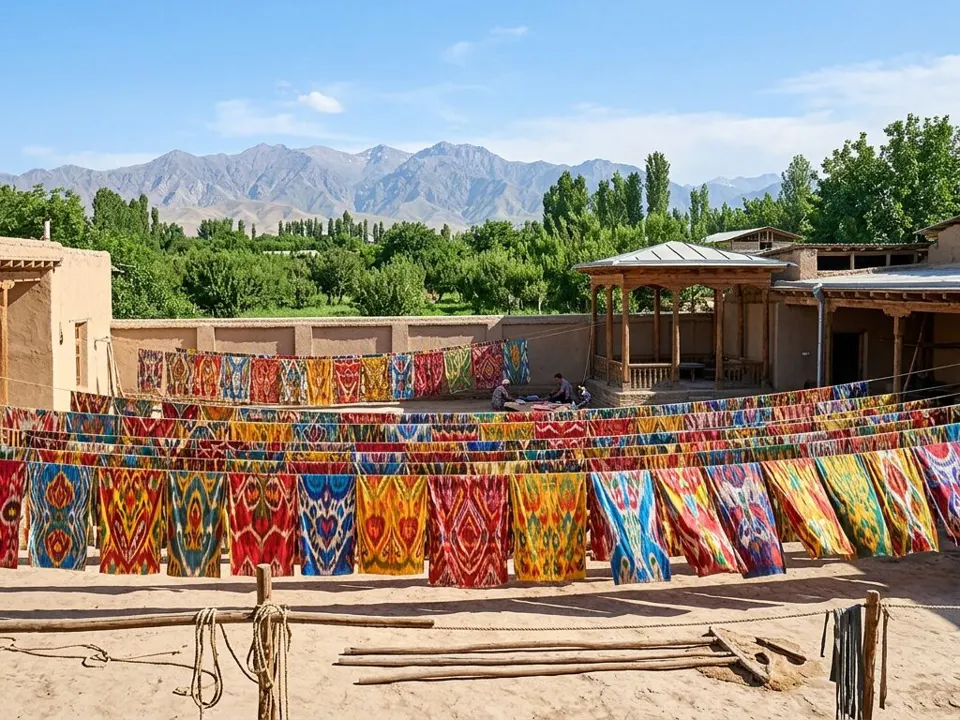
In Margilan the Yodgorlik silk factory still works by hand: cocoons are boiled and reeled, the threads are tied and dyed in sections (abr, “cloud”) and then woven on wooden looms. Khan-atlas is pure silk; adras mixes silk and cotton and is sturdier. The blurred, flame-like patterns are the hallmark of true hand-made ikat.
Silk carpets of Samarkand and Bukhara
Workshops such as Samarkand’s Hujum and Bukhara’s carpet cooperatives revived pure-silk hand-knotted carpets in Persian and Turkmen designs. A good silk carpet has 400 to 1,000 knots per square inch and takes one weaver months to finish.
Suzani embroidery
Large embroidered hangings were once part of every bride’s dowry. Bukhara suzani are delicate, Nurata pieces feature flowering bushes, and Samarkand and Shahrisabz designs are bold and colourful.
Workshops & classes
Yodgorlik in Margilan is open to visitors daily and lets you try tying or weaving. The Hujum workshop in Samarkand and Bukhara’s carpet workshops near the Lyabi-Hauz show natural dyeing with pomegranate, madder and indigo. In late May Margilan hosts the Atlas Bayrami festival.
Miniature painting & Samarkand paper
Samarkand paper was prized across the Islamic world from the 8th century. The craft nearly vanished and was revived in the 1990s – today it again supplies miniaturists and calligraphers.
Konigil paper mill
In the village of Konigil near Samarkand, the Meros workshop of the Mukhtarov brothers makes paper from mulberry bark using a water-driven wooden mill. The bark is boiled, beaten into pulp, pressed and polished with stone until it shines and lasts for centuries.
Bukhara and Samarkand miniatures
Miniature artists paint court scenes, poets, hunting parties and caravan motifs with natural pigments and single-hair brushes on Samarkand paper, papier-mâché boxes and lacquer. Bukhara masters, often working in madrasa cells, continue the Herat and Bukhara schools.
Calligraphy
Calligraphers write verses of Navoi, Rumi and Omar Khayyam in nastaliq script. A personalised calligraphy – your name or a short poem – is a light, meaningful souvenir.
Workshops & classes
At Konigil you can make your own sheet of paper in about an hour and stay for lunch in the garden. In Bukhara the workshops in the Nadir Divan-Begi and Abdulaziz Khan madrasas show miniature painting in progress.
Wood & ganch carving, gold embroidery & metalwork
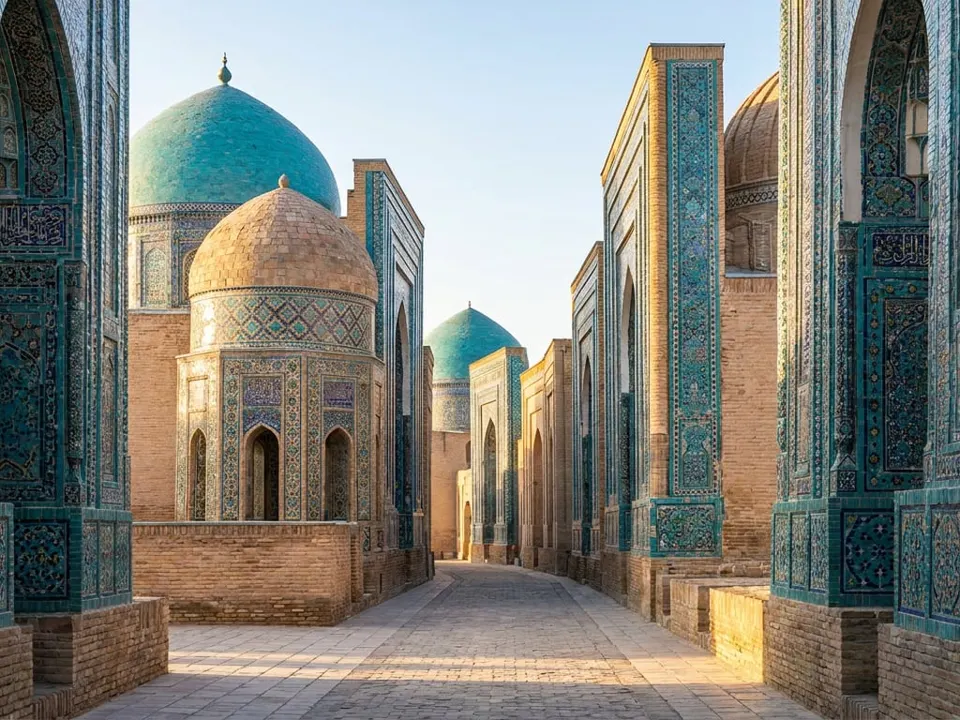
Uzbek architecture is decorated by hand, and the same masters supply the souvenir trade. These crafts are a highlight of any city walk.
Wood carving (Khiva, Tashkent)
Khiva’s Juma Mosque stands on 213 carved elm columns, some over a thousand years old. Today’s carvers make doors, columns, Quran stands (lauh) that fold from a single block and chests in walnut, elm and plane-tree wood.
Ganch (carved stucco)
Ganch, a gypsum plaster, is carved while still damp into lace-like panels and mihrabs. The Tashkent and Bukhara schools decorate palaces and modern buildings; small framed panels make fragile but unique souvenirs.
Zardozi gold embroidery (Bukhara)
Once reserved for the emir’s court, zardozi uses gold and silver thread on velvet for robes, skullcaps, bags and wall panels. Genuine work is heavy, slightly raised and stitched on a frame by hand.
Knives and copperware
Chust in the Fergana Valley and Bukhara’s blacksmiths forge pchak knives with horn, bone or wood handles and engraved blades. Copper chasers in Bukhara’s trading domes engrave plates, jugs and trays with floral and geometric patterns.
Workshops & classes
In Khiva the carving workshops near the Ichan Kala gates and the suzani centre welcome visitors. In Bukhara the Zardozi factory, the Taqi Zargaron dome and the blacksmith workshop of Shokir Kamolov show the process; in Tashkent visit Chorsu bazaar and the Museum of Applied Arts.
Practical buyer & customs tips
Mass-produced copies from abroad are sold next to genuine work in tourist bazaars. A few simple checks – and the right paperwork – make the difference.
Telling hand-made from factory-made
Ceramics: hand-painted lines vary slightly in width and the underside shows the potter’s mark or unglazed clay; printed decals look perfectly identical on every piece.
Ikat: genuine abr patterns have soft, blurred edges and the design shows on both sides; printed fabric is sharp on one side only.
Carpets: turn the carpet over – hand-knotted pieces show every knot on the back and the fringe is part of the warp, not sewn on.
Silk: real silk feels cool and warms in your hand; a burnt thread smells of hair and turns to powder, while synthetic melts into a bead.
Suzani and zardozi: look at the back for slightly irregular hand stitches; machine embroidery is uniform and often backed with glue.
Buy where the work is made: workshops sell at fair prices, explain the technique and often sign the piece.
Customs and luggage rules
Carpets and suzani: ask the seller for a receipt and an export certificate; items over 50 years old need permission from the Ministry of Culture and may not be exported.
Ceramics: wrap plates in clothes and pack them in hand luggage; many workshops also ship by courier.
Knives and blades: they must go in checked luggage, never in hand luggage. Decorative pchak are allowed, but some countries restrict blade length on import – check your home country’s rules.
Antiques, old coins and manuscripts need official export permits; without them they can be confiscated at the airport.
Keep all receipts until you are home: they prove value and origin to customs in Uzbekistan and at home.
Rules change and differ by country; your guide will confirm the current requirements before you buy anything large or old.
Signature crafts of the other eight countries
From nomad felt in the steppe to stone carving in the Caucasus, every country has its own living tradition. These profiles show what to look for and where to find it.
Kazakhstan
Kazakh crafts grew out of nomadic life: everything had to be beautiful, durable and easy to load on a horse or camel.
Felt carpets: syrmak and tekemet
Syrmak are mosaic carpets of cut and stitched felt with bold ram’s-horn motifs; tekemet are pressed felt with patterns rolled into the wool.
Leatherwork
Embossed leather flasks (torsyk), belts, saddles and cases decorated with stamped and appliqué ornament.
Silver jewellery (zergerlik)
Massive bracelets, rings and headdresses with carnelian and turquoise, made by zerger silversmiths to protect and adorn.
Dombra crafting
The two-stringed dombra is carved from a single piece of wood; masters in Almaty and Astana still make them by hand.
Where to see and buy: Almaty’s Central State Museum and the craft shops on Panfilov Street, and the Kazakh crafts fairs held around Nauryz in March.
Georgian crafts combine Byzantine elegance with village traditions, and many are linked to the country’s 8,000-year wine culture.
Minankari enamel
Cloisonné enamel jewellery in which coloured glass is fused into fine gold or silver cells, revived from medieval icon art.
Lurji supra blue tablecloths
Hand-printed blue tablecloths with wooden stamps – a nearly lost craft revived by Tbilisi artisans.
Qvevri making
Huge clay wine vessels coiled by hand and buried in the ground; the method is UNESCO-listed. Villages in Kakheti and Imereti keep the craft.
Felt and wool
Felt scarves, hats and the shepherd’s nabadi cloak from Tusheti and the mountains.
Where to see and buy: The Dry Bridge market and enamel studios in Tbilisi’s old town, and the qvevri masters of Vardisubani in Kakheti and Shrosha in Imereti.
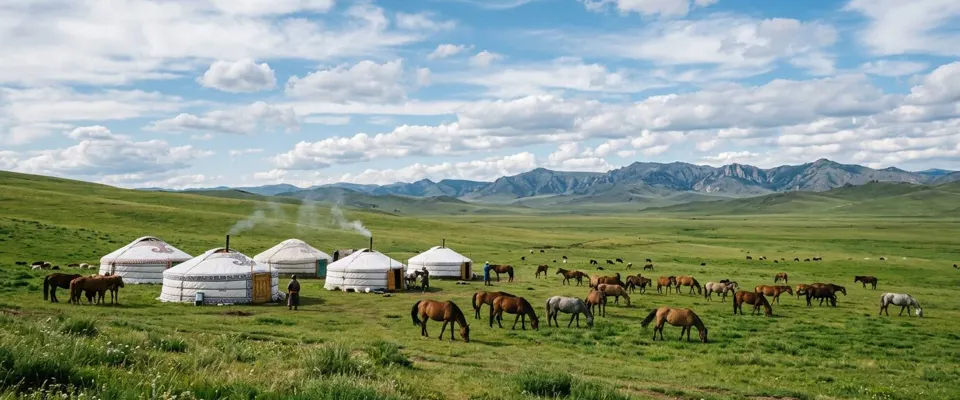
Mongolian crafts serve the nomadic life on the steppe: portable, warm and decorated with Buddhist and shamanic symbols.
Ger woodworking and painting
Doors, poles and furniture of the ger are painted in orange, red and blue with endless knots and other auspicious patterns.
Felt-making
Families make felt each autumn by rolling wet wool behind a horse; felt slippers, toys and rugs are popular souvenirs.
Cashmere and camel wool
Mongolia is the world’s second-largest cashmere producer; camel wool from the Gobi is hand-spun into socks and blankets.
Calligraphy, saddles and boots
Vertical Mongolian script is written by calligraphers; silver-decorated saddles and the upturned gutal boots are masterworks of leather.
Where to see and buy: The Mongolian Artists’ Exhibition Hall and cashmere factory shops in Ulaanbaatar, and felt-making cooperatives in the countryside.