
Uzbekistan travel guide
Discover Uzbekistan with local experts
The heart of the Silk Road: Samarkand, Bukhara, Khiva and living traditions
Uzbekistan
At a glance
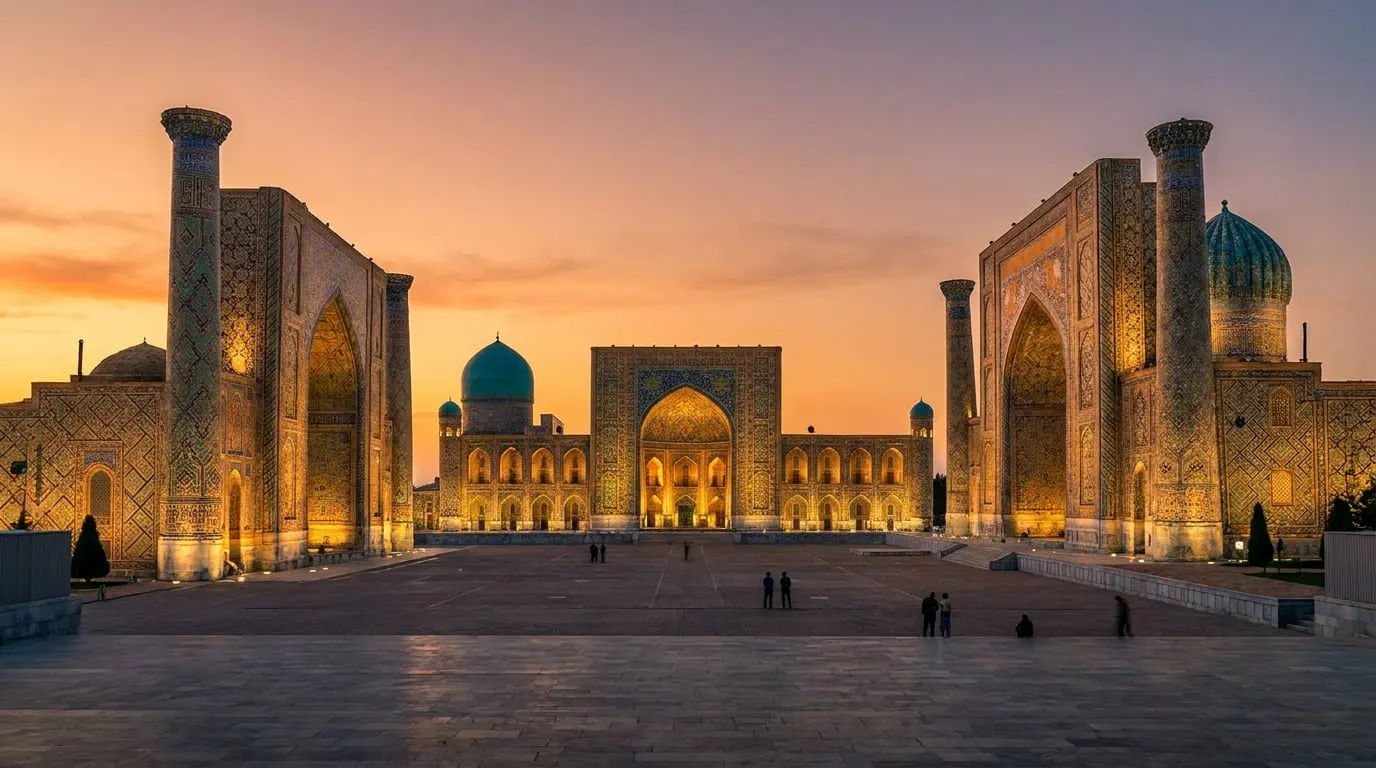
Uzbekistan is the cultural heart of Central Asia and our home. Its oasis cities of Samarkand, Bukhara and Khiva were the great stopovers of the Silk Road, and their mosques, madrasas and mausoleums, covered in turquoise tiles, are among the finest Islamic architecture in the world.
Beyond the monuments lies a country of bustling bazaars, craft workshops, desert yurt camps, the green Fergana Valley and the mountains near Tashkent. Fast Afrosiyob trains link the main cities, and the famous Uzbek hospitality makes every visit personal.
With visa-free entry for many nationalities, a rich festival calendar and one of the best cuisines in Asia, Uzbekistan is the perfect start to any Silk Road journey.
Seasons & weather: when to visit
- Spring · Ideal
- Summer · For the prepared
- Autumn · Ideal
- Winter · Good
Spring
March – May
15–28 °C, sunny, occasional showers
The most beautiful season: gardens in bloom, green hills and the Navruz celebrations on 21 March. Ideal for city sightseeing, the Nuratau mountains and desert yurt camps.
Ideal
Summer
June – August
33–42 °C in the cities and deserts, dry
Very hot in Bukhara, Khiva and the Kyzylkum, so we start early and rest at midday. Cooler in the Chimgan mountains and the Fergana Valley; melon season and the Silk and Spices Festival time.
For the prepared
Autumn
September – November
12–30 °C, dry and golden
Warm days, cool nights and markets full of grapes, pomegranates and melons. September and October are perfect; November is quieter and fresh.
Ideal
Winter
December – February
-5 to +10 °C, occasional snow
Crisp and quiet, with snow sometimes dusting the domes of Samarkand. Few visitors, low prices and skiing at Amirsoy and Chimgan near Tashkent.
Good
Regional climate notes
- Khiva and Karakalpakstan have the hottest summers and the coldest winters of the country.
- The Fergana Valley and Tashkent region are greener and milder, protected by mountains.
- In the Kyzylkum desert, nights in the yurt camps are cool even in summer: bring a warm layer.
Culture & traditions
Uzbek life revolves around family, the mahalla (neighbourhood community) and hospitality. Guests are welcomed with green tea and bread, weddings gather hundreds of people, and craftsmanship is passed from father to son for generations.
- Mahalla: neighbourhood communities that organise weddings, celebrations and mutual help.
- Tea houses (choyxona) where men meet over green tea, plov and conversation.
- Shashmaqom classical music, Khorezm Lazgi dance and the epic songs of the bakhshi.
- Traditional dress: the chapan robe, the embroidered doppi skullcap and atlas silk dresses.
- Weddings (to’y) with karnay trumpets, dancing and a morning plov for the guests.
- Islam is practised moderately; mosques and shrines welcome respectful visitors.
UNESCO heritage of Uzbekistan
Uzbekistan holds the densest concentration of Silk Road monuments in the world, from the turquoise domes of Samarkand to the mud-brick walls of Khiva, together with living traditions recognised by UNESCO.
Samarkand – Crossroads of Cultures
Registan Square, the Gur-e-Amir mausoleum of Timur, the Bibi-Khanym Mosque and the tiled necropolis of Shah-i-Zinda (UNESCO, 2001).
Historic Centre of Bukhara
More than 140 monuments, from the 10th-century Samanid Mausoleum to the Kalyan Minaret, the Ark fortress and the Lyab-i Hauz pool (UNESCO, 1993).
Itchan Kala, Khiva
A complete walled inner city of madrasas, palaces and minarets, the first site in Central Asia inscribed by UNESCO (1990).
Historic Centre of Shahrisabz
Timur’s birthplace, with the colossal ruins of the Ak-Saray Palace and the Dorut Tilovat complex (UNESCO, 2000).
Silk Roads: Zarafshan–Karakum Corridor
A cross-border chain of caravanserais, ancient cities and trade routes between Uzbekistan, Tajikistan and Turkmenistan (UNESCO, 2023).
Western Tien-Shan & Cold Winter Deserts of Turan
Natural heritage shared with neighbours: the Chatkal mountains near Tashkent and the desert ecosystems of the Kyzylkum.
Living traditions
Shashmaqom music, the Boysun cultural space, Navruz, Askiya humour, palov culture, Khorezm Lazgi dance, the art of the bakhshi storytellers and atlas and adras silk weaving are inscribed on UNESCO’s intangible heritage lists.
Crafts you can see in the workshops
- Ikat silk (atlas and adras) in the Yodgorlik factory in Margilan.
- Blue-and-green ceramics in Rishtan, and Gijduvan pottery near Bukhara.
- Hand-made mulberry paper at the Konigil workshop near Samarkand.
- Suzani embroidery, gold embroidery in Bukhara and woodcarving in Khiva.
- Knife makers in Chust and copper chasing on the trading domes of Bukhara.
Festivals & holidays
Navruz
When: 21 March (celebrations for several days)
Where: Nationwide
The Persian New Year and the start of spring, the most loved holiday. Families cook sumalak all night, towns hold concerts, kurash wrestling, horse games and fairs, and everyone visits relatives.
Independence Day (Mustaqillik kuni)
When: 1 September
Where: Nationwide, main events in Tashkent
The national holiday marks independence in 1991 with concerts, fireworks and festive programmes in every city.
Sharq Taronalari – Melodies of the East
When: Late August, every two years
Where: Registan Square, Samarkand
An international music festival held since 1997 on the Registan, with musicians from dozens of countries competing in traditional music under the floodlit madrasas.
Silk and Spices Festival
When: Usually late May or June
Where: Bukhara
The old city fills with craftsmen, silk and spice traders, dancers, puppeteers and tightrope walkers, recreating the atmosphere of a Silk Road bazaar.
Boysun Bahori – Boysun Spring
When: Spring (April – May)
Where: Boysun, Surkhandarya
A folklore festival of the Boysun mountains, whose ancient rituals, songs and crafts are recognised by UNESCO. Expect yurts, folk theatre, kupkari horse games and wrestling.
International Bakhshi Art Festival
When: Spring, every two years since 2019
Where: Termez (first edition) and other regions
Epic storytellers (bakhshi) from Central Asia, Turkey, Azerbaijan and beyond perform the great oral epics with dombra accompaniment. The bakhshi art is UNESCO heritage.
International Maqom Art Forum
When: Usually September, every two years since 2018
Where: Shahrisabz
Performers and scholars of maqom, the classical music of Central Asia and the Middle East, meet in Timur’s birthplace for concerts and a competition.
Melon Festival (Qovun sayli)
When: August
Where: Khorezm, Tashkent and farming regions
A celebration of the famous sweet melons of Uzbekistan, with tastings of dozens of varieties, competitions for the biggest melon, music and folk games.
Stihia Festival
When: Dates vary; held since 2018
Where: Moynaq, Karakalpakstan
An electronic music and art festival on the former shore of the Aral Sea, among the ship graveyard, raising awareness of the ecological disaster.
Ramadan Hayit (Ramazon hayit)
When: End of Ramadan; expected around 9–10 March 2027
Where: Nationwide
Eid al-Fitr, a public holiday. Families visit relatives, share festive tables and give to those in need. Some restaurants have shorter hours during Ramadan.
Kurban Hayit (Qurbon hayit)
When: 70 days after Ramadan Hayit; expected around 16 May 2027
Where: Nationwide
Eid al-Adha, the Feast of Sacrifice and a public holiday, when families share meat with neighbours and the poor and visit the graves of ancestors.
Key regional festivals
International Lazgi Dance Festival
When: Spring or autumn; dates vary by year
Where: Khiva and Urgench, Khorezm
A celebration of Lazgi, the joyful Khorezm dance inscribed by UNESCO, with ensembles from across Uzbekistan and abroad dancing in the old city.
Atlas Bayrami – Festival of Atlas and Adras
When: Usually autumn
Where: Margilan, Fergana Valley
The silk capital of the Fergana Valley shows off its ikat weavers, designers and fashion shows, with open workshops and craft markets.
International Festival of Handicrafters
When: Autumn, in festival years
Where: Kokand, Fergana Valley
Masters of ceramics, woodcarving, embroidery and metalwork from dozens of countries gather in the old khanate capital.
Asrlar Sadosi – Echo of Centuries
When: Dates vary; the host region changes
Where: Rotating between regions
A national festival of traditional culture with folk ensembles, epic singers, wrestling, games and crafts from every region.
Golden Autumn harvest fairs
When: September – October
Where: Tashkent, Samarkand, Fergana Valley
Markets overflow with grapes, pomegranates, melons and nuts, and towns hold harvest fairs and folk concerts.
Tashkent International Film Festival
When: Autumn, in festival years
Where: Tashkent
The revived “Pearl of the Silk Road” film festival brings screenings, premieres and guests from across Asia and Europe.
Festival dates are set each year by the organisers and the government, and Islamic holidays move about 11 days earlier every year. We confirm exact dates when we plan your trip.
National cuisine
Uzbek cuisine is generous and seasonal. Meals start with tea, bread, salads and fruit, followed by soup and a main course. Each region has its own plov, and bazaars are a feast for the senses.
Plov (osh)
The national dish of rice, carrots, lamb and spices cooked in a kazan; UNESCO intangible heritage. Tashkent, Samarkand and Bukhara each have their own version.
Samsa
Flaky pastries baked in a tandoor, filled with meat and onion, pumpkin or spring herbs.
Lagman
Hand-pulled noodles with meat and vegetables, served in broth or stir-fried.
Shashlik
Skewers of lamb, beef, chicken or liver grilled over charcoal and served with onions.
Manti & chuchvara
Steamed dumplings with meat and pumpkin, and small boiled dumplings in broth.
Non
Round tandoor bread, decorated by stamp; Samarkand non is famous across the country.
Shurpa & mastava
Hearty soups of meat and vegetables, and of rice with vegetables and herbs.
Sumalak & halva
Sumalak, a sweet wheat-sprout paste cooked all night for Navruz, and the many halvas of the bazaars.
Practical tips from our team
- Book Afrosiyob high-speed train seats early: they sell out weeks ahead in spring and autumn.
- Bring some cash in clean dollar or euro notes; cards work in cities, cash is needed in bazaars.
- Keep your hotel registration slips until you leave the country.
- Dress modestly for mosques and shrines; a scarf for women is useful.
- Bargaining is expected in bazaars, friendly and with a smile.